
There is a neighborhood in Lower Manhattan where 19th-century cast-iron facades line cobblestone streets, where the world’s largest collection of industrial-era architecture now houses fashion boutiques and contemporary art galleries, and where every block tells a story of reinvention so dramatic it has become a model for urban transformation worldwide. This is SoHo, short for South of Houston Street, and its history is one of the most fascinating urban narratives in America.
I first walked these streets as a young professional in the hospitality industry, and what struck me was the tension between what SoHo was and what it had become. The ornate iron columns framing a luxury storefront. The freight elevator in a loft that once hauled textile bales. SoHo doesn’t hide its past. It wears it on its facade, literally.
A Neighborhood of Many Lives

The land that became SoHo has been reinvented more times than almost any other patch of New York. In the 17th century, the Dutch West India Company granted parcels here to formerly enslaved Africans, making it one of the city’s first free Black settlements. By the early 19th century, it had become a fashionable residential neighborhood, then a thriving retail and entertainment district centered along Broadway, with grand hotels, department stores, and (less grandly) one of New York’s most notorious concentrations of brothels.
The mid-1800s brought the innovation that would define SoHo’s physical identity: cast-iron architecture. James Bogardus, widely credited as the pioneer of the technique, demonstrated that cast iron could be molded into ornate facades far more cheaply and quickly than carved stone. Foundries along the East and Hudson Rivers produced Corinthian columns, arched window frames, and decorative cornices that were bolted onto building fronts, flooding previously dark industrial interiors with light through their oversized windows. The Haughwout Building, erected in 1857 at the corner of Broadway and Broome Street, is one of the finest surviving examples and holds another distinction: it was the site of the world’s first successful passenger elevator, installed by Elisha Graves Otis.
By the early 20th century, the textile and manufacturing industries had moved on, and SoHo declined into what locals called Hell’s Hundred Acres, a bleak stretch of empty warehouses, sweatshops, and parking lots that came alive during the day and emptied completely at night. In the 1960s, city planner Robert Moses proposed the Lower Manhattan Expressway, an elevated highway that would have cut directly through the neighborhood along Broome Street, demolishing most of what stood in its path. The project was fought and ultimately defeated in 1969 by a coalition led by urbanist Jane Jacobs and preservation advocate Margot Gayle, in what became one of the landmark victories of the American preservation movement.
The Artists Who Saved the Buildings
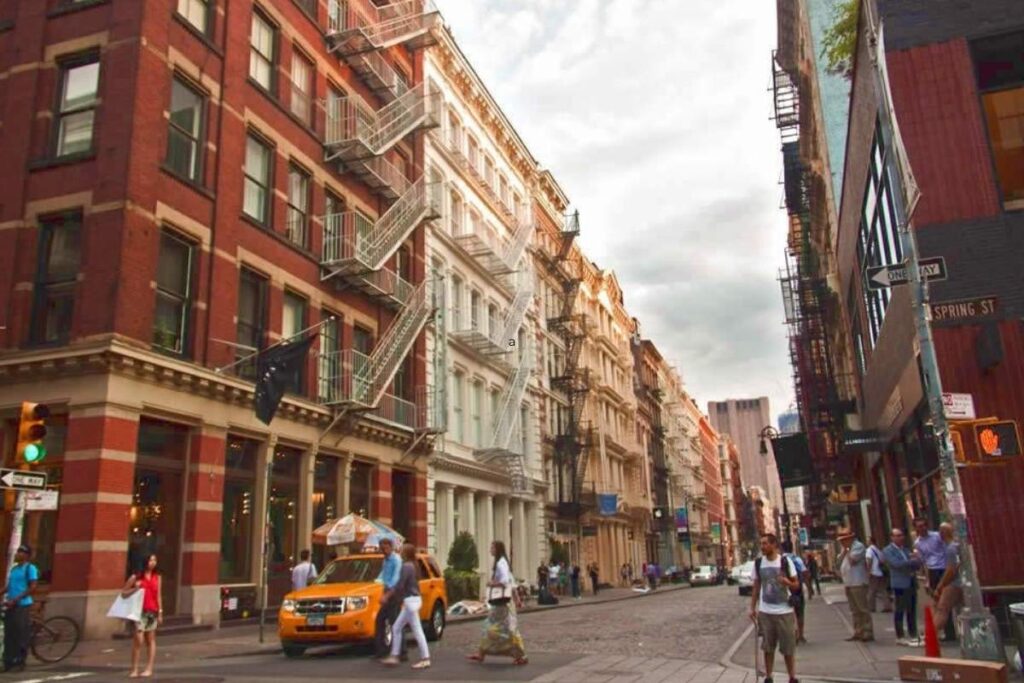
What happened next is the story that made SoHo famous. In the 1960s and 1970s, artists began moving into the abandoned manufacturing lofts, drawn by the high ceilings, enormous windows, open floor plans, and extremely low rents. The spaces were zoned for commercial and industrial use, meaning residential occupation was technically illegal. Artists lived and worked in their lofts quietly, often without heat or running hot water, until the city created a special zoning designation in 1971 that allowed certified artists to reside in SoHo’s industrial buildings.
What followed was an explosion of creative energy. Galleries opened on nearly every block. Paula Cooper, Leo Castelli, and Mary Boone established spaces that defined the contemporary art world. Donald Judd, Jean-Michel Basquiat, and Chuck Close lived and worked in SoHo lofts. The neighborhood became synonymous with the New York avant-garde.
The New York City Landmarks Preservation Commission designated the SoHo-Cast Iron Historic District in 1973, protecting approximately 500 buildings across 26 blocks. The district was listed on the National Register of Historic Places and declared a National Historic Landmark in 1978. This protection preserved the architectural fabric even as the neighborhood’s identity continued to shift.
By the 1990s, rising rents had begun pushing artists out, replaced by fashion brands and luxury retailers. The pattern of industrial decline, artist colonization, cultural cachet, and commercial transformation has been repeated in neighborhoods worldwide, from Shoreditch in London to Wynwood in Miami. Urban planners call it the SoHo Effect.
Walking the Streets

SoHo’s grid runs roughly from Houston Street in the north to Canal Street in the south, with Broadway on the east and Sixth Avenue (or, depending on your source, West Broadway or Varick Street) on the west. Many of the side streets are still paved with Belgian blocks, the heavy rectangular stones that have survived beneath the feet of two centuries of New Yorkers.
Greene Street is the architectural showcase. Between Canal and Houston, it contains the longest continuous stretch of cast-iron facades in the city. Look up and you’ll see Italianate, neo-Grec, and Second Empire designs rendered in iron, each building slightly different, each a product of its foundry’s particular molds and its architect’s interpretation of European styles.
The Richard Haas trompe l’oeil mural at Prince and Greene Streets has been a neighborhood landmark since 1975, painting the illusion of a cast-iron facade onto a blank brick wall with such precision that visitors regularly mistake it for the real thing. At 599 Broadway, Forrest Myers’ sculpture The Wall, an eight-story minimalist work installed in 1973, is still sometimes called The Gateway to SoHo.
For visitors who want to understand the relationship between the architecture, the art, and the social history, a private cultural walking tour through SoHo connects the dots in ways that wandering alone rarely can. The buildings look beautiful from the outside, but the stories behind them, who built them, who saved them, who transformed them, are what give the neighborhood its real weight.
SoHo’s creative legacy extends beyond the galleries to the streets themselves. Murals, wheat-paste installations, and large-scale works by artists like ROA, Tristan Eaton, and Ken Hiratsuka (whose granite carvings are embedded in the sidewalk at Prince and Broadway) turn the neighborhood into an open-air gallery that changes with the seasons. A street art tour through SoHo reveals layers of visual culture that most visitors walk past without noticing, from political statements on side-street walls to commissioned works on building facades.
And because SoHo sits at the intersection of several of Manhattan’s most distinctive neighborhoods, a walking tour that connects SoHo, Little Italy, and Chinatown covers three radically different cultural identities within a compact, walkable area, each one shaped by its own waves of immigration, commerce, and reinvention.
Eating in SoHo
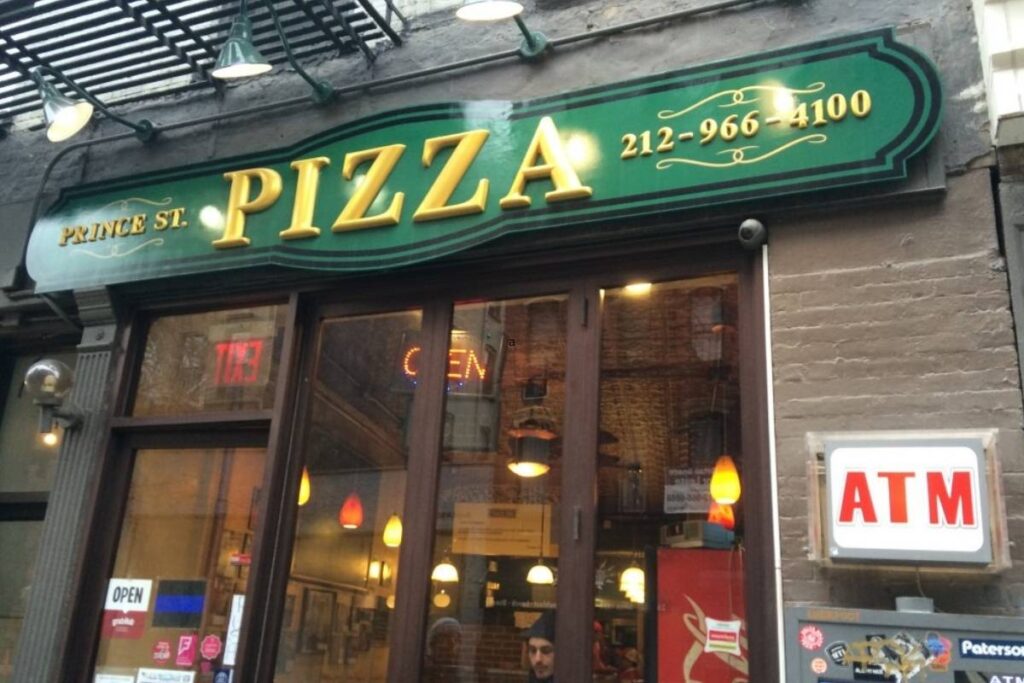
SoHo’s food scene has evolved alongside everything else. The neighborhood today offers an eclectic range that reflects both its artistic roots and its current status as one of Manhattan’s most sought-after dining destinations.
Balthazar, Keith McNally’s French brasserie on Spring Street, has been a neighborhood institution since 1997. Dominique Ansel Bakery, also on Spring Street, became a global phenomenon with the Cronut. For something more casual, Prince Street Pizza’s thick, pepperoni-studded Sicilian square has achieved near-legendary status among New York pizza enthusiasts.
The weekend brunch culture in SoHo is deeply established, and a brunch walking tour with tastings is one of the best ways to sample the neighborhood’s range without committing to a single table. You move between spots, tasting as you go, and the guide provides context about the neighborhood’s culinary evolution between stops.
For travelers who want to go deeper into SoHo’s food identity, a seasonal food tour focuses on what’s current, connecting the neighborhood’s restaurants, bakeries, and specialty shops to the ingredients and traditions that define them at that particular time of year. It’s an approach that treats food as culture rather than just consumption, which is exactly how New Yorkers think about eating.
The Neighbors
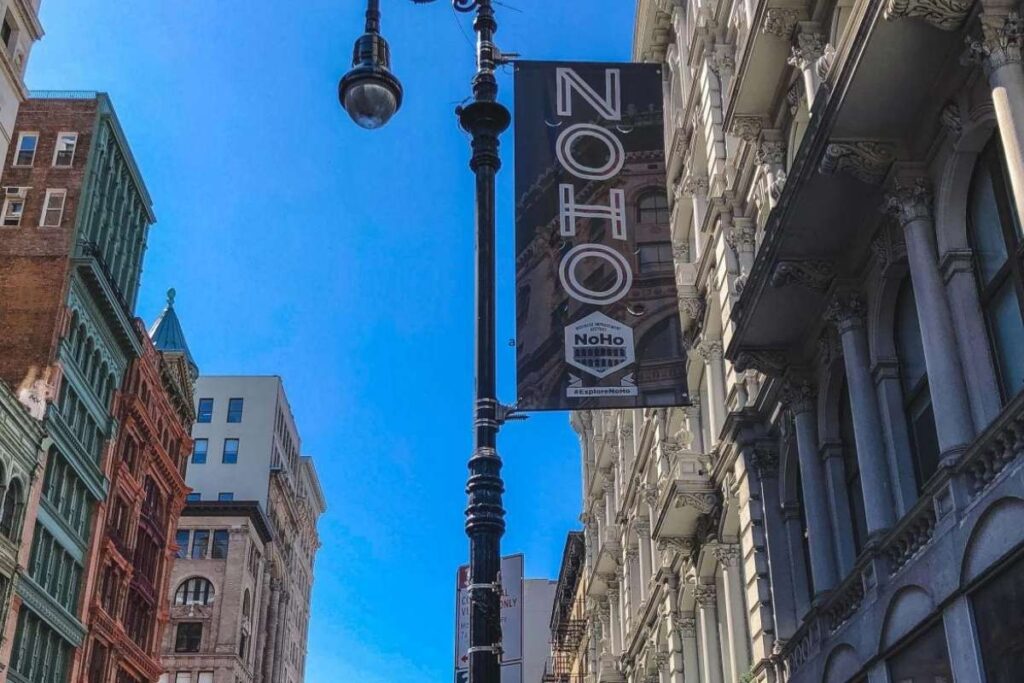
Part of SoHo’s appeal is its position within Manhattan’s geography. NoHo (North of Houston) sits directly above, sharing much of the same architectural DNA but with a quieter character. Nolita (North of Little Italy), immediately to the east, has become a destination for independent boutiques and specialty coffee.
Little Italy, compressed into a few blocks along Mulberry Street, retains the visual markers of its immigrant heritage. Chinatown, just south of Canal Street, remains one of the largest Chinese-American communities in the Western Hemisphere, with dim sum parlors, herbal medicine shops, and produce markets that have operated for generations.
Getting There and Getting Around
SoHo is served by several subway lines. Broadway-Lafayette (B, D, F, M), Spring Street (C, E on Sixth Avenue; 6 on Lafayette), and Prince Street (N, R, W) all place you within the neighborhood.
The neighborhood is compact enough to explore on foot in a few hours, though spending an entire day is easy. The side streets reward slow walking: look up for the architecture, look down for the Belgian blocks, and look around for the street art and the constant, kinetic energy of one of the most creatively layered neighborhoods in the world.